
- $HAS
Peaks Don't Compound: The Case Against HAS
HAS at publication: $119.09 · Close on October 30, 2026
Since publication: Loading latest close…
Source: ChartExchange · Closing prices, not live quotes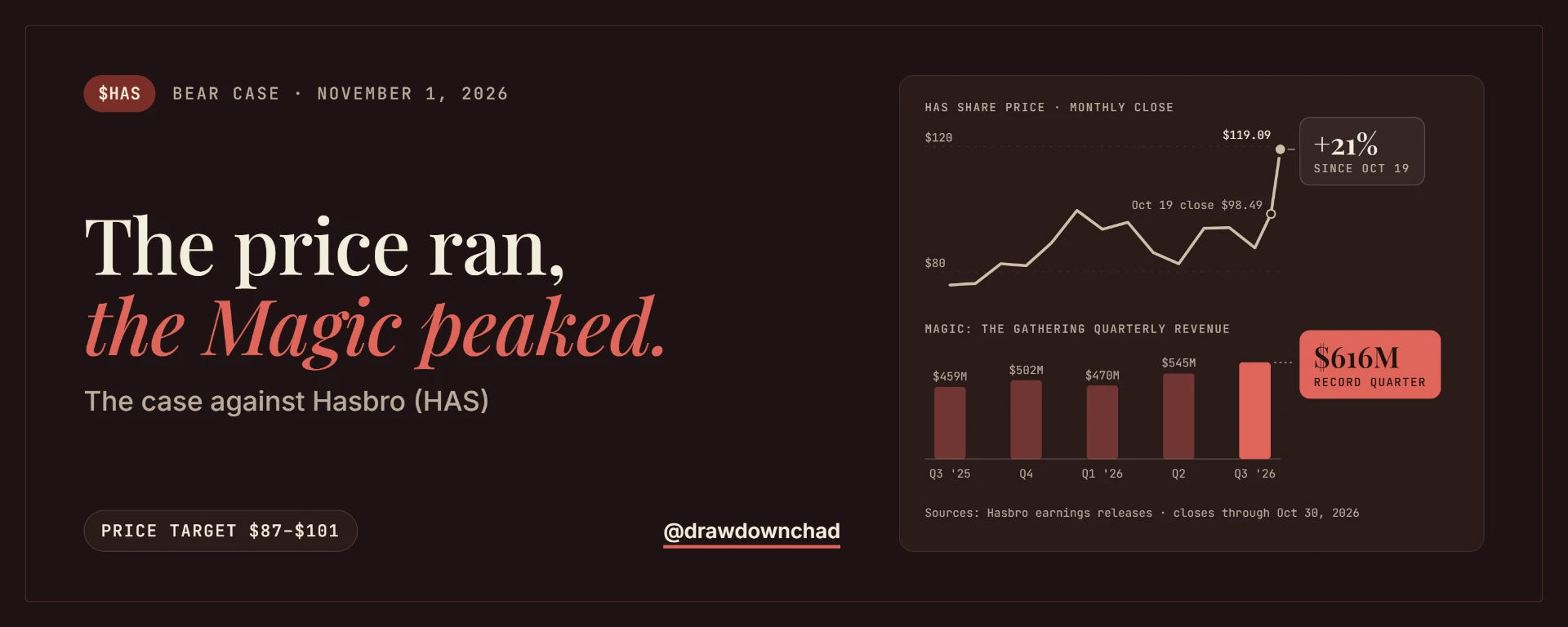
Hasbro closed at $119.09 on Friday, up 21% from its $98.49 close the day before its October 20 earnings report and within 2% of its 52-week high. On the chart alone, the old toy company looks like a compounding machine. The latest quarter explains the run. It also explains why I think the run is done.
Revenue rose 15% to $1.6 billion, adjusted earnings per share jumped 73% to $2.90, and Magic: The Gathering hit a record $616 million, up 34%. Now look closer. About $55 million of that profit was one-time tariff refunds, and roughly $40 million of Magic sales planned for the fourth quarter shipped early. Strip out the refunds and adjusted operating margin drops from 33.9% to about 30.5%.
The market is pricing a peak like it's a floor. Cracks exist.
Under the Record
Magic is now 38.6% of Hasbro's revenue, up from 33.1% a year ago, and Wizards of the Coast, the segment that sells it, kept 49.2% of its sales as operating profit versus 44.0%. Four of Magic's seven main sets this year are Universes Beyond, licensed franchises like Final Fantasy, Marvel and The Hobbit, which management says carry higher royalty costs. Each hit is rented from someone else's franchise, sold once and has to be topped by the next.
The borrowed fans are buying. Final Fantasy became the best-selling Magic set ever and The Hobbit ranks fourth. But this is what peak monetization looks like: more sets, pricier packs and record sales to people who showed up for Gandalf, while management already pegs 2027 Magic growth at mid-to-high single digits, down from 34%. Rented hype comes with a lease.
Consumer Products, still the biggest segment, grew just 4% to $828 million, and management expects 1% to 3% for the full year. Licensing revenue, now including Monopoly Go, was $144 million and is down 4% year to date. Hasbro also took a $56 million impairment on digital games this year, an admission some projects are worth less than it spent. Toys sell one hit at a time through cautious retailers.
To be fair, toy profit more than doubled. But $48 million of that $174 million was tariff refunds, and most of the rest came from cost cuts, which you only get to make once. Magic's $157 million year-over-year gain was five times the $31 million the whole toy segment added in sales. Cost cuts aren't growth.
Pokémon, which Collectr says makes up 65% of tracked collector activity, has seen its newest rare cards fall 20% to 45% from late-2025 peaks in price-tracker data, and One Piece has passed Magic for second in that activity. If Magic gave back this quarter's $157 million gain for a full year, that's about $627 million of revenue and roughly $310 million of operating profit at this quarter's Wizards margin. Hobby stores make up 70% of Magic sales, so they feel any collector pullback first.
Granted, Hasbro's CEO calls trading cards, now the top category in toys, a generational shift. Every craze looks structural from the top. My thesis doesn't need Magic to shrink, because management's 2027 guidance for slower Magic growth and high-30s Wizards margins already flattens earnings. A crash is extra credit.
The Multiple and the Risks
The price is my problem. At about 17.8 times this year's expected earnings, you're paying $17.80 per dollar of profit, a growth price for earnings analysts see rising less than 2% next year, from $6.70 to $6.81. The stock jumped 11% on earnings day and kept climbing, and the average analyst target of $119.08 now sits right on the share price. Even the bulls are out of upside.
Hasbro has stumbled before. Revenue fell from $6.42 billion in 2021 to $4.14 billion in 2024, and it wrote off about $1.2 billion of goodwill (the premium paid for acquisitions) in 2023 and another $1.0 billion in 2025. The market never paid up for that version: 11 to 16 times forward earnings at each year-end from 2022 through 2025. If earnings flatten and the multiple drifts back there, the stock falls even if nothing else breaks.
Two things could break my case, and neither has failed yet: Magic has grown in 15 of the last 17 years by Hasbro's count, and Exodus, a video game launching April 7, 2027 with about one million wishlists, could be a hit. What decides this is Magic's growth rate and the Wizards margin, and management already guides both lower for 2027. The price says the boom is the baseline. The guidance says it's ending.
My price target: $87 to $101
My target is $87 to $101 a share. From the October 30, 2026 close of $119.09, that's 15% to 27% downside, before the 2.4% dividend.
Here's the math.
1. Start from this year's estimate. Analysts expect adjusted EPS of $6.70 for 2026.
2. Hold it flat through 2027. I assume 0% growth, so 2027 EPS stays at $6.70, a bit under the Street's $6.81, because tariff refunds won't repeat, game costs push Wizards margins into the high 30s and Magic growth slows. I'm leaving out any outright drop in Magic sales.
3. Apply a toy-company multiple. I use 13 to 15 times earnings, below today's 17.8 and inside Hasbro's 2022 to 2025 range: $6.70 × 13 = $87.10, or $87, and $6.70 × 15 = $100.50, or $101.
The multiple does the heavy lifting. If the market keeps paying 17.8 times flat earnings, the stock goes nowhere ($6.70 × 17.8 = $119.26), and even 8% growth to $7.24 only gets you $94 to $109 at my multiples ($7.24 × 13 = $94.12; $7.24 × 15 = $108.60). The case that makes my target look generous: if the craze cools hard and EPS falls 20% to $5.36, the same multiples give $70 to $80.
Bottom line
Hasbro used to be the Monopoly and Nerf company. Now it's a Magic company with a toy business attached, posting records on licensed sets, early shipments and one-time refunds. The stock prices that as permanent and hasn't caught down to management's own 2027 guidance. Peaks don't compound.
Disclosure: I have no position in HAS at time of article publishing. This isn't investment advice.